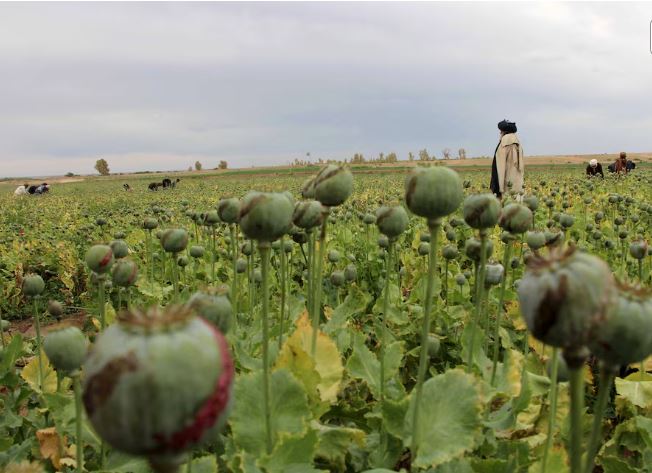
KABUL: A recent survey conducted by the United Nations Office on Drugs and Crime (UNODC) indicates that Afghan farmers’ adherence to the Islamic Emirate’s leader’s decree banning drug cultivation remains high.
The office published the survey today, which was conducted in the provinces of Balkh, Badakhshan, and Kunduz, reveals that farmers have not been able to compensate for their lost income after ceasing poppy cultivation.
According to the report, 85 percent of respondents stated they have either not found any alternatives to poppy cultivation or have managed to recoup only a portion of their lost income.
Meanwhile, 15 percent of the farmers surveyed mentioned that they recovered their lost income from alternative crops.
The United Nations emphasized that the lack of alternative crops has inflicted economic shocks on farming communities, highlighting an urgent need for support for their livelihoods.
The report notes that cereals, particularly wheat, have become the predominant alternative crop, with over 90 percent of respondents in each province mentioning it. Analysis of satellite images by UNODC across the country confirms this trend.
However, focusing on alternative crops and the livelihoods of Afghan farmers has been a key demand from the Islamic Emirate’s officials in discussions with international partners in the fight against drugs.
It is noteworthy that in spring 2022, the leader of the Islamic Emirate issued a decree banning drug cultivation across Afghanistan.
UN survey: Afghan farmers’ compliance with drug cultivation ban remains high