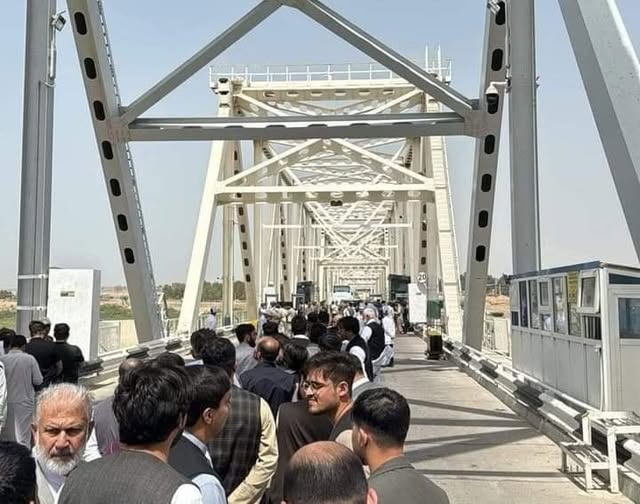
KABUL: Senior officials of Afghanistan and Uzbekistan’s railway sector have decided, during a meeting in the port town of Hairatan that operations at the Hairatan port will run around the clock.
According to a statement from the Herat governor’s press office on Friday night, in the meeting, the Afghan delegation, led by Mullah Mohammad Ishaq Sahibzada, Deputy Minister of Railways at the Ministry of Public Works, and the Uzbek delegation, led by Hakmatullah Rahmatov, Deputy Minister of Railways and Minister of Transport of Uzbekistan.
The main goal of the talks, according to the statement, is to increase the shipment of essential and commercial goods through the Hairatan railway corridor.
The statement adds that with Hairatan port services becoming 24/7, transport services will expand, access to laboratory services will be easier, transfers will increase, and by raising the number of wagons from 130 to about 500 to 700 significant economic changes are expected in both Afghanistan and Uzbekistan.
Hakmatullah Rahmatov said the level of trade between Kabul and Tashkent is growing, adding that increased cargo shipments via the railway lines between the two countries will help reduce prices. He said costs are expected to drop by around 20 to 25 percent.
Meanwhile, Mullah Mohammad Ishaq Sahibzada, Deputy Minister of Railways at Afghanistan’s Ministry of Public Works, said the Hairatan route is among the better, easier, and cheaper options for transporting goods and assured Uzbekistan that Afghanistan is fully committed to cooperating in this area.
The statement quoted Sahibzada as saying that practical steps have been taken to facilitate the process especially loading and unloading and that these services will continue 24 hours a day to provide more convenience for traders and to increase overall transport volumes.
The Hairatan railway line is described as one of the important ports in northern Afghanistan, providing rail connections between Afghanistan and Central Asian countries, especially Uzbekistan.
Kabul, Tashkent to launch round-the-clock operations at Hairatan